Tag Archives: root chakra

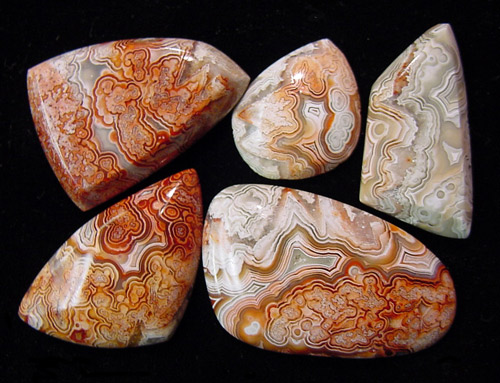
About Stones: Crazy Lace Agate

CrazyLace3

Astrological Sign: Aries
Chakra: Root, Solar Plexus
Lore: Crazy lace agate helps us to reach extremely high physical levels. Use to help recover from bio-rhythmic lows. It encourages laughter and provides insight into the many paths leading to awareness.
Geology: Crazy Lace Agate, or Mexican Lace Agate, is a variegated form of chalcedony displaying lace configurations or paisley patterns in a combination of red, white, gray and yellow.
Locality: Mexico

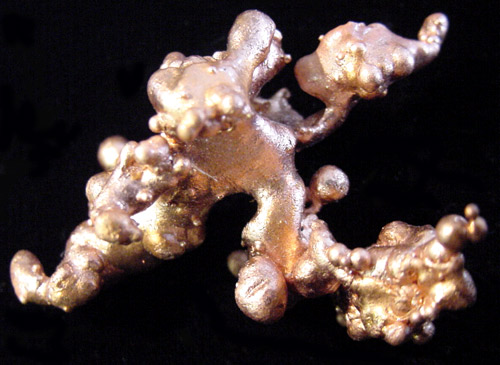
About Stones: Copper

copper

Astrological Sign: Taurus, Sagittarius
Chakra: Root, Sacral
Lore: Copper stimulates initiative, optimism, diplomacy, and independence. It can magnify the transfer of energy from other minerals or from a healer due to its ability to conduct electrical impulses. It is reputed to bring luck, especially in the recovery of property.
Geology: Copper is a native element forming in volcanic rocks and sulfide deposits. The usual habits are dendritic and massive, rarely crystaline in the form of cubes and octahedrons. Michigan’s native copper is used to form these interesting sculptures which are man made on the Keweenaw Peninsula. Molten copper at 2200 degrees Fahrenheit is poured into straw which is immersed in water. The straw is burned away and the copper solidifies. On New Years day, according to custom, early miners used lead in the same process as a method of fortune telling. Good or bad luck for the year to follow was determined by the shape and size of the sculpture formed.
Localities: Michigan, Arizona, Germany

About Stones: Carborundum

carborundum

Astrological Sign: Capricorn
Chakra: All
Lore: The silicon content in laboratory produced carborundum has similar properties to that of natural quartz. It has been employed for memory enhancement and to improve manual dexterity. Use to amplify positive feelings.
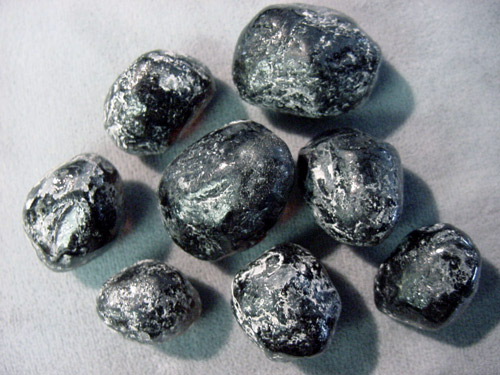
Geology: Carborundum, or silicon carbide is a man-made mineral invented in Pennsylvania by Edward Goodrich Acheson in 1890. The result of a failed attempt to create diamonds, carborundum was formed from electrically fusing a mixture of clay and carbon. Carborundum, used as an industrial abrasive, is hard enough to scratch glass. More recently it has been employed as a semiconductor. Silicon carbide, found in Arizona within a Canyon Diablo meteorite by Dr. Ferdinand Henri Moissan, has been named Moissanite. With a tetrahedral crystalline structure and an appearance similar to diamond, naturally occurring moissanite is rare. Gem quality moissanite is being manufactured and sold as a low cost alternative to natural diamonds.
Locality: Man made in Poland

About Stones: Bismuth

bismuth

Astrological Sign: Aquarius
Chakra: All
Lore: Bismuth is a stone for transformation, allowing for orderliness and calm during the state of change. It stimulates cohesiveness in groups and relationships, supporting progression towards a common goal. Bismuth relieves feelings of emotional and spiritual isolation.
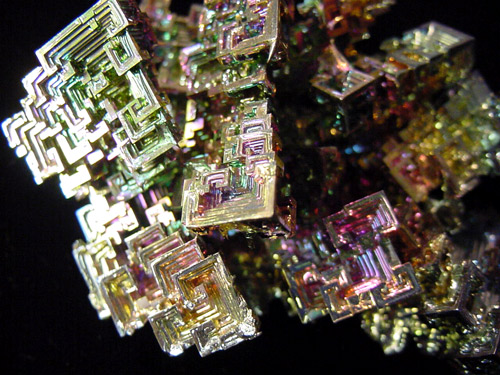
Geology: Bismuth is a silvery-white metal. Lab-grown “Hopper” crystals have a stairstep shape resulting from the edges growing more quickly than the crystal faces. Irridescent surface colors are due to surface oxides.
Locality: Laboratory grown in Germany

About Stones: Bertrandite

bertrandite

Astrological Sign: Pisces, Capricorn, Aquarius
Chakra: Root, Sacral
Lore: Bertrandite supports a smooth transition when undergoing change. It assists in the verbalization of hidden feelings. Bertrandite is reputed to enhance sexual energy.
Geology: This relatively new material, an opalized fluorite, is also called Beryllium Opal,  “Tiffany Stone”  and Ice Cream Opalite. It occurs in a mixture of cream or white opalite with purple fluorite, traces of yellow bertrandite, along with other red or black mineral inclusions. Mineralized beryllium nodules altered by a fluorine-rich solution form in the sequence dolomite-calcite-chalcedony-opal/fluorite. The nodules are recovered from an area where the bertrandite rock is mined commercially for the recovery of beryllium used in the manufacture of satellites and aircraft. Bertrandite is beryllium silicate hydroxide.
Composition: Be4Si2O7(OH)2
Hardness: 6-7
Locality:  Brush Wellman Beryllium Mine, Juab County, Delta, Utah

About Stones: Apache Tear

apachetear

Astrological Sign: Aries
Chakra: Root
Lore: Traditionally, the apache tear is said to be one of the tears shed by Native American women in mourning for their warriors who were driven from a cliff by the U.S. cavalry. It is used for comfort in times of grief, providing insight and acceptance.
Geology: The apache tear is a small black nodule of obsidian or volcanic glass. The main obsidian flow has been altered to a whitish porous rock called perlite containing unaltered transparent glassy nodules.
Locality: Arizona

About Stones: African Bloodstone

africanbloodstone

Astrological Sign: Taurus, Cancer, Leo
Chakra: Root, Sacral, Solar Plexus
Lore: Bloodstone is also known as heliotrope, Greek for “solstice,” referring to its powerful healing power. It aids in the renewal of physical and emotional states. A stone of courage, it helps to revitalize love relationships and friendships. Bloodstone has the capacity to clear scattered thoughts in preparation for meditation.
Geology: Bloodstone is a chalcedony, a microcrystalline variety of quartz. It is colored an opaque green with red spots caused by hematite and other iron oxides. African Bloodstone is sometimes called “Seftonite.” 
Localities: India, Africa, Australia

About Stones: Abalone Shell

abalone

Astrological Sign: Pisces
Chakra: Root, Solar Plexus
Lore: Abalone shells are used to enhance smudging activities. The shells, revered by ancient tribes as magical gifts from the sea, were one of the earliest forms of wealth. They stimulate fertility of mind and body and improve self-image and physical power.
Biology: Abalone are mollusks with one-piece shells. They belong to the genus Haliotis which means “sea ear.” They are rounded or oval with a row of respiratory pores along one side.
Locality: Mexico