Tag Archives: throat chakra

About Stones: Carborundum

carborundum

Astrological Sign: Capricorn
Chakra: All
Lore: The silicon content in laboratory produced carborundum has similar properties to that of natural quartz. It has been employed for memory enhancement and to improve manual dexterity. Use to amplify positive feelings.
Geology: Carborundum, or silicon carbide is a man-made mineral invented in Pennsylvania by Edward Goodrich Acheson in 1890. The result of a failed attempt to create diamonds, carborundum was formed from electrically fusing a mixture of clay and carbon. Carborundum, used as an industrial abrasive, is hard enough to scratch glass. More recently it has been employed as a semiconductor. Silicon carbide, found in Arizona within a Canyon Diablo meteorite by Dr. Ferdinand Henri Moissan, has been named Moissanite. With a tetrahedral crystalline structure and an appearance similar to diamond, naturally occurring moissanite is rare. Gem quality moissanite is being manufactured and sold as a low cost alternative to natural diamonds.
Locality: Man made in Poland

About Stones: Blue Lace Agate

bluelace

Astrological Sign: Pisces
Chakra: Throat, Heart, Brow, Crown
Lore: Blue lace agate is a highly inspirational influence when used for inner attunement. Use to reach high spiritual spaces and enter into high-frequency states of awareness. Blue lace agate helps build confidence in public speaking by encouraging focus and calm centeredness. 
Geology: A variegated form of chalcedony or microcrystalline quartz, blue lace agate displays a blue and white lace pattern.
Localities: Brazil, Uruguay, Mexico

About Stones: Bismuth

bismuth

Astrological Sign: Aquarius
Chakra: All
Lore: Bismuth is a stone for transformation, allowing for orderliness and calm during the state of change. It stimulates cohesiveness in groups and relationships, supporting progression towards a common goal. Bismuth relieves feelings of emotional and spiritual isolation.
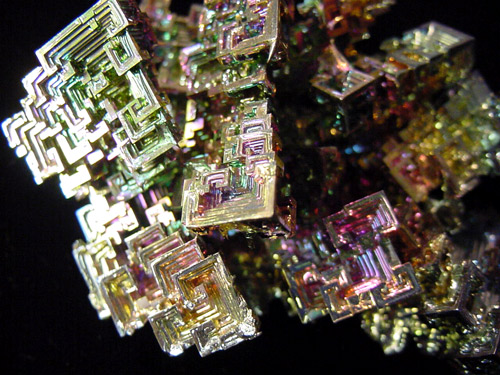
Geology: Bismuth is a silvery-white metal. Lab-grown “Hopper” crystals have a stairstep shape resulting from the edges growing more quickly than the crystal faces. Irridescent surface colors are due to surface oxides.
Locality: Laboratory grown in Germany